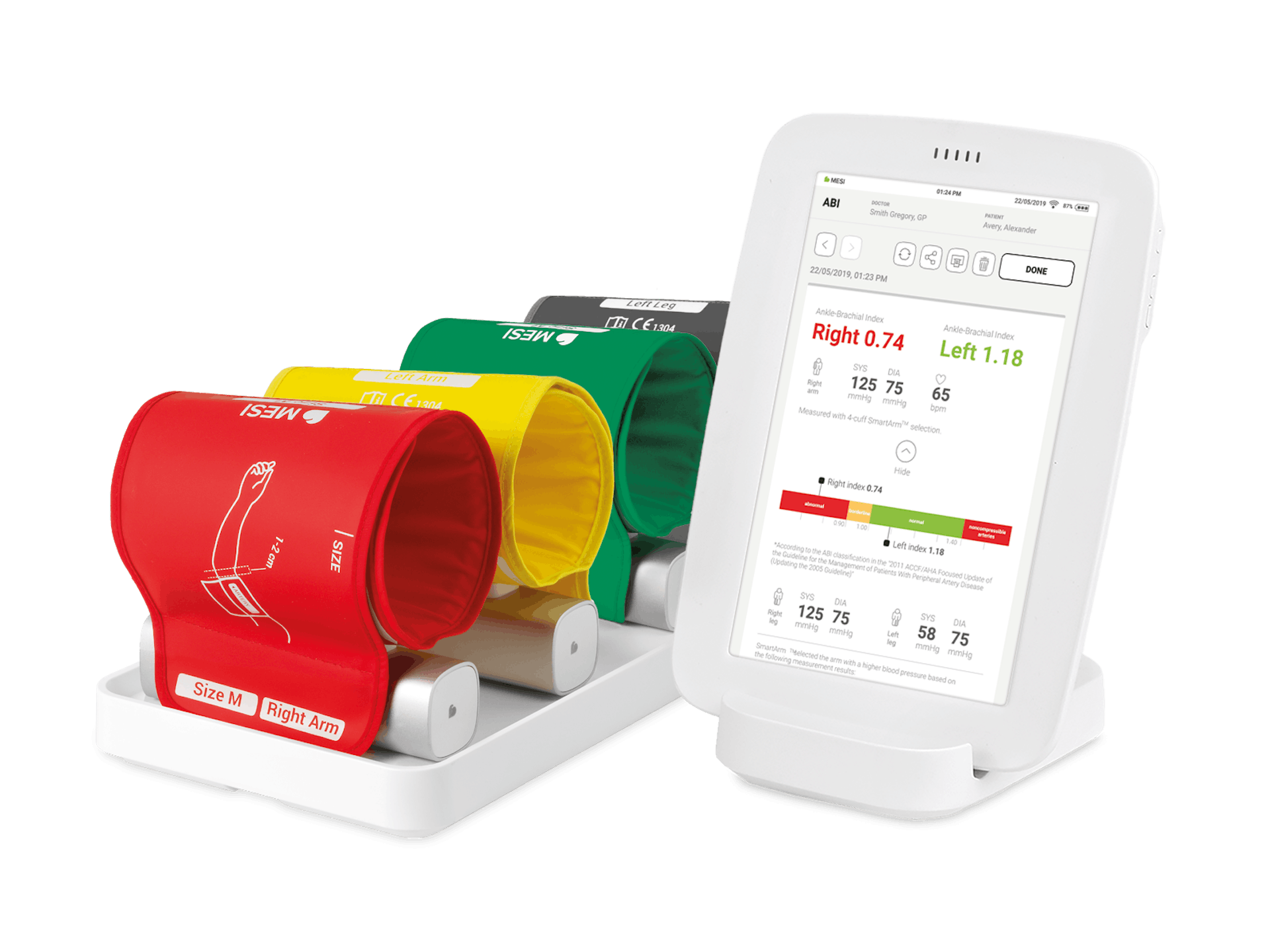
MESI mTABLET ABI module
Key information and support documentation about the MESI mTABLET ABI module.
Video tutorials


Additional resources

Quick guide
Download s quick guide document about the wireless medical tablet system MESI mTABLET.

Technical specification
Technical specifications providing essential product details.

Print service
This desktop software enables direct printing from the MESI mTABLET as well as direct measurement storage to the local PC or server in PDF format.
Latest version: 2.0.0
Frequently asked questions
This device has a unique ability to detect severe peripheral artery disease (PAD). In cases of severe PAD, blood flow in the arteries is severely limited, meaning the oscillations essential for measuring ankle pressure may be absent. This depends heavily on the elasticity of the arteries. If no oscillations are detected, the ABI cannot be calculated; however, the device will analyse the pulse waveform and alert you to the presence of severe PAD. You can confirm the result by examining the full pulse waveforms on the MESI Results report on your computer. If blood flow is limited but there is sufficient elasticity, the device will calculate the ABI.
If the arteries are calcified, the device will display a PAD message. This indicates that the shape of the pulse waveform should be examined. This can help you determine whether the arteries are simply calcified or also blocked.
The device does not detect arrhythmia itself, but measurements can still be taken regardless. If there are too many absent pulses due to the condition, the algorithm does not have enough data to calculate the ABI, and the 'E4 error' ('an error occurred during heart rate calculation') will be displayed. If the condition is not severe, the ABI is calculated as usual.
- in case of the presence of intravenous cannulas or arteriovenous fistulas, the cuffs and measurement can cause injury to the limb,
- if the patient has had breast surgery/mastectomy,
- do not use the device on a patient while they are connected to a vital sign monitor,
- do not use immediately post-op following a superficial bypass graft without consulting a physician first,
- do not carry out if the patient has severe lower leg pain or severe lower leg wound pain without consulting a physician first,
- do not use for patients with dermatitis, pulmonary hypertension, severe hypertension, Parkinson’s or very oedematous limbs,
- do not use with patients who have severe heart failure, gangrene or a recent skin graft on the upper or lower extremity.
Heartbeats create oscillations in the plethysmographic signals, which are used to calculate blood pressure values in three limbs. The ankle cuffs measure oscillometric signals across the entire ankle, detecting the highest systolic blood pressure of all the arteries within the ankle (both the tibial artery and the dorsalis pedis artery). The ankle pressure is then compared to the brachial pressure to calculate the ABI.
If the patient can withstand a one-minute measurement, the cuffs must be covered with an impermeable dressing before being placed on wounded extremities. Otherwise, enable the amputation mode (see image below) before starting the measurement.
With MESI devices, blood pressure drift does not occur as measurements are taken simultaneously in the upper and lower extremities. In our opinion, the best practice would be to have the patient lie in a supine position and remain still and silent during the measurement. A slight angle should not affect the result significantly, but we recommend putting a small pillow or other form of support under the patient’s head and knees, especially if they have a tremor or are unable to stay still. This will not affect the measurement, as the cuffs will be at the same level; however, the patient will feel more comfortable. We would definitely not recommend that the patient sits up.
We temporarily block the blood flow in the arteries. If we were to block the blood flow in all four limbs, which have large arteries, the blood would have nowhere else to go but the head. This would increase the chance of cardiac overload in some high-risk patients. This is why we first inflate the two arms to determine the inter-arm difference, and then take three cuff measurements. This is not necessary with TBI because the small arteries in the toes do not affect overall circulation; that's why we can perform four simultaneous cuff measurements.
When we compare the arm, we can see clearly pronounced pulses and a distinct lemon shape, showing that the artery has responded to compression and release. Each pulse is clear, with a distinct difference between systole and diastole.
In contrast, when we look at the waveform of the right leg, there are no clear pulses and it mostly looks like noise.
No, because these are ultrasound waveforms. Our device does not use an ultrasound probe. We receive pressure waveforms. We have a digital cuff that momentarily stops the blood flow by inflating and then deflating. As it starts to deflate, we capture the oscillations (single heartbeats). These oscillations are then high-pass filtered and, through the algorithm, we receive the ABI calculation.
Errors
If the error is repeated, critical ischaemia may be present. Check the positioning of the cuffs and take the measurement again.
Remind the patient to stay still while the measurement is being taken, and then repeat the measurement.
Refer to the instructions for use for information on cuff placement. Check the position of the cuff, then take another measurement.
Repeat the measurement. If the error is repeated, it means that the measured value is outside the device's measurement range.
Repeat the measurement. If the error is repeated, the measured value is outside the measurement range of the device.
Please check that the cuff is positioned correctly, and refer to the instructions for use to ensure that the correct size has been chosen. If you experience any problems, please contact Support.
The cuff is either not attached, or not attached correctly. Please ensure that the cuff is positioned in accordance with the IFU. Also, check that you are using the correct size of cuff.
Repeat the measurement. If the error is repeated, it means that the measured value is outside the device's measurement range.
Repeat the measurement. If the error is repeated, it means that the measured value is outside the device's measurement range.
Repeat the measurement. If the error is repeated, it means that the measured value is outside the device's measurement range.