The proven value of ABI measurement: the Australian case
Peripheral arterial disease (PAD) is common, often goes undetected, and can be costly when overlooked. By routinely measuring the ankle-brachial index (ABI) in the right patients and using the existing Medicare rebate, general practices can improve patient outcomes and keep the service self-sustaining.
The rebate that supports preventive care
Because PAD is prevalent in older and high-risk patients seen routinely in primary care, the eligible cohort is meaningful: adults ≥65 years; ≥50 years with risk factors such as diabetes or smoking; and anyone with exertional leg pain or non-healing wounds suggestive of PAD. Diabetes-foot guidance in Australia goes further, recommending PAD assessment (including bedside ABI) for all diabetes-related foot ulcers. In short, the clinical indications and the rebate align.
Late PAD diagnosis is costly. Australian data put a major amputation’s acute hospital cost at ~$43,000, with open surgery ~$31,900 and endovascular angioplasty ~$18,400; that’s before rehab and prosthetics. Preventing even a single amputation can underwrite hundreds of ABI assessments. Earlier diagnosis triggers secondary prevention (lipids, blood pressure, antiplatelet therapy, smoking cessation, exercise), reducing downstream admissions and complications.
MBS (Medicare Benefits Schedule) sets a schedule fee, which is the amount the Australian Government deems appropriate for a service and uses to calculate the rebate. For ABI, the current schedule fee is AUD $74.30. For out-of-hospital services, Medicare pays 85% of that fee as the rebate; about AUD $63.15 per test (often rounded to $63.20 for planning). Clinics use this 85% figure as a conservative revenue baseline because it’s the minimum they’ll receive if they bulk-bill.
Measuring the benefits in practice
A conservative model for a suburban clinic illustrates the point. At ~8 tests per week (≈400/year), using $63.20 per test, annual billings reach $25,280. Over three years, that’s $75,840 against an outlay of roughly $6,250 for an automated ABI device; a ~12:1 ROI (rounded down). The device is covered by a three-year warranty, so revenue predictability is high, and ongoing costs are minimal.
Time is usually the barrier in primary care. An automated system solves that: no patient rest time and a complete test in just over two minutes from cuff placement to result. Nurses can run it with minimal training, and the output is more than a single number. With direct EHR integration, results attach instantly to the correct patient, avoiding printing/scanning and manual uploads; many clinics secure this with zero setup cost and a modest monthly fee.
Why early detection matters
PAD hides in plain sight. Around 15% of Australian adults are affected; roughly one in five people over 65 have PAD, and many are asymptomatic or atypical. Relying on partial examinations and history alone misses cases. Timely ABI measurements reveal disease when there’s still time to intervene. The human impact is obvious, but the financial signal is just as clear: fewer admissions for limb-threatening ischemia and wound complications, and contextualised specialist referrals.
A game changer in day-to-day practice
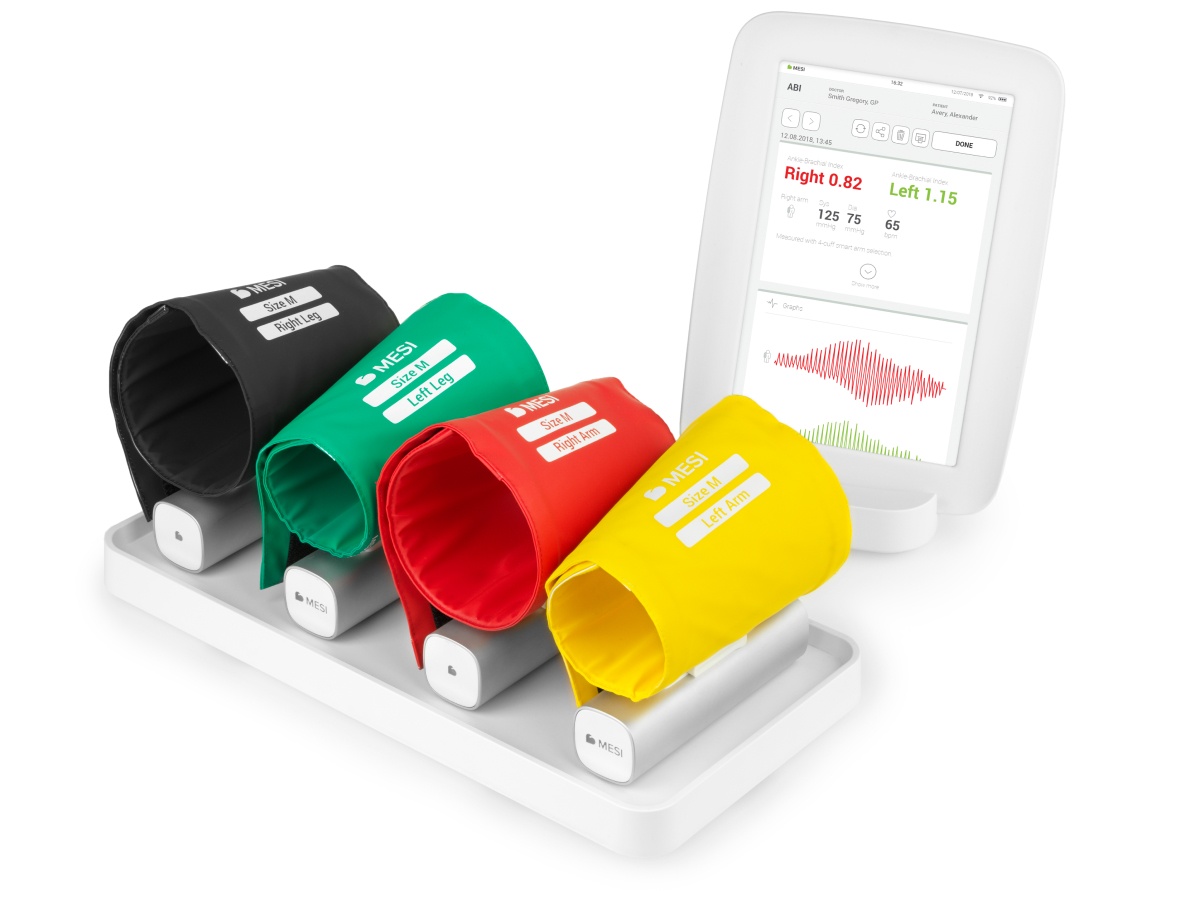
For clinics, the device choice determines whether ABI becomes a habit or a hassle. MESI mTABLET ABI is automated and wireless, so nurses complete the entire assessment in just over two minutes with no patient rest time. The report includes the ABI value, individual pressures, oscillation graphs, and pulse waveforms, which simplifies referrals and follow-up. Results sync straight into the EHR to the correct patient record, reducing admin and errors.
The system ships as a complete kit (wireless ABI modules, medical-grade tablet, charging dock, MESI mRECORDS access), carries a full three-year warranty, and supports additional apps like blood pressure and a photo app for wound documentation; a single platform covers vascular assessment and related chronic-care needs.
ABI is one piece of a broader cardiovascular picture. The MESI mTABLET platform was designed for Integrated Diagnostics: ABI, TBI, ECG, BP, SpO₂, spirometry and vital signs run on one system, integrated into clinical workflows and the EHR, and easily shared with colleagues or specialists. In practice, that means fewer devices to learn and maintain, fewer vendor logins, less duplication of data entry, and a tighter pathway from screening to decision. Clinicians can move from ABI to BP or ECG in seconds without leaving the encounter or breaking documentation flow, turning each visit into a complete risk assessment rather than a fragmented series of appointments.