Empowering general practices: how Integrated Diagnostics drives efficiency and patient satisfaction

Using real-world examples from the UK and Germany, this blog shows how integrated diagnostics boosts workflow efficiency, reduces consultation times, and improves both staff experience and patient outcomes.
How can digital tools streamline general practices?
Opening or managing an established private general practice has many advantages in comparison with working in public healthcare, but it also comes with a set of challenges, which are similar to those faced by small business owners [1]. Physicians who run their own practices must be part medical doctors and part entrepreneurs if they want their business to not only attract and retain patients through high-quality care but also create an attractive working environment for skilled staff, whose contributions are essential to both patient satisfaction and clinical outcomes [2].
In addition to their clinical responsibilities, they must handle the financial, administrative, and legal responsibilities of operating a business. However, poor balancing of these demands can compromise the overall quality of care and pose serious risks to the long-term viability of their private practice. It is no mystery that physicians generally dislike administrative tasks, and those who spend a significant portion of their time on such duties are more likely to report lower career satisfaction and be at an increased risk of burnout [3]. A malignant phenomenon that not only takes a significant personal toll, but it also leads to a wide range of negative consequences – including reduced patient satisfaction, increased incidence of unprofessional behaviour, a decline in overall professionalism, more frequent medical errors, and a rise in malpractice claims [4] – [13].
Nevertheless, the solution to the burden of administrative tasks isn’t simply hiring more or better staff since they, most often those are nurses, can quickly become overwhelmed themselves and suffer burnout as a result. This not only compromises the quality of care but is also associated with direct financial costs – one study estimated that the turnover of a single nurse can cost up to $58,400 [14], [15]. If the staff turnover is particularly high, there are other harmful ramifications: increased mortality rates, more frequent medical errors, disrupted continuity of care, and greater patient dissatisfaction [16]–[22]. Moreover, it reduces overall staff productivity due to understaffing and can lower morale among remaining team members, potentially triggering a snowball effect of further turnover [23]–[26].
A better and more sustainable solution is the use of an electronic health record (EHR) system that can greatly simplify the handling of administrative tasks, streamline workflows, and cut costs. However, not all EHR systems are well-suited for private practices, and if poorly implemented, they can create more problems than they solve. Studies have shown that inadequate training (i.e., low technological literacy) in EHR usage can lead to increased job stress, reduced job satisfaction, higher burnout rates among physicians and nurses, and a rise in medical errors [27]–[30]. The latter is paradoxical phenomenon since the use of EHRs is generally associated with lower rates of medical errors – with the caveat that the users are properly trained in their use.
Still, medical errors, often caused by seemingly trivial issues like illegible handwriting (most often in pharmacy settings where accurate medication prescriptions are critical), remain a significant challenge for healthcare organizations [31]. They may range from relatively benign with no harmful consequences to those that cause adverse, and sometimes fatal, patient outcomes [32], [33]. In connection with the latter one study suggested that just in the United States, medical errors are the third leading cause of death, responsible for over 251,000 deaths annually [34]. Wider adoption and proper use of EHRs can mitigate this problem to a significant extent. Research has shown that physicians who use EHRs have a history of fewer paid malpractice claims in comparison to their peers who use traditional paper medical records [35].
Unfortunately, in many healthcare settings, even in those with the latest, most advanced medical devices and equipment, paper-based processes still dominate when it comes to transferring diagnostic data into EHRs (or paper records). This reliance on manual transcription not only increases the risk of errors (the problem of illegible handwriting) but also consumes valuable time. There was even a study done that compared timeliness and (data) accuracy of three different data management protocols for transferring and recording vital sign data [36]. The first protocol involved writing data on paper and then transcribing it into a paper record, the second required transcribing handwritten notes into an EHR, and the third allowed direct data entry into an EHR via a tablet mounted next to the vital signs monitor [36]. Unsurprisingly, the third method proved to be the fastest and most accurate, a finding supported by other research highlighting the benefits of using EHRs for recording vital signs data [36]–[38].
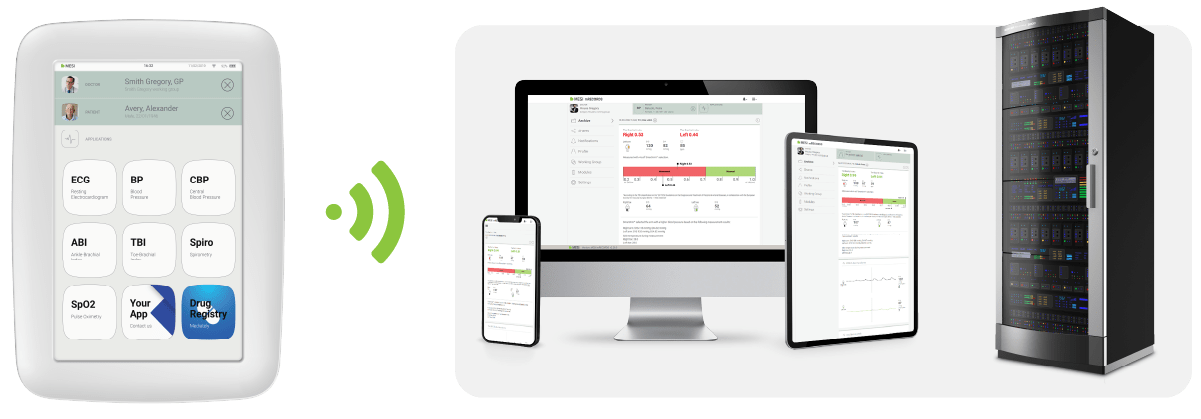
Measuring vital signs is of course a fundamental diagnostic procedure performed in virtually every general practice. However, the protocols and efficiency of these procedures can vary significantly. Practices that utilize EHRs usually operate more efficiently, though the used protocols can differ widely. Traditionally, vital signs (blood pressure, heart rate, oxygen saturation, etc.) are measured using analogue tools, with results manually entered into EHRs using a PC. Or they can be measured using modern diagnostic tools that automatically and wirelessly transfer measurement data directly into a cloud-based EHR system from where they can be instantly accessed from any web-enabled device. While this may still sound like science fiction to some, it is already a reality for a growing number of general practices that have embraced the future of digital diagnostics.
In what ways does the MESI mTABLET make consultations more efficient and informed?
The MESI mTABLET diagnostic system is this future, offering a comprehensive solution for general practice – for monitoring vital signs and beyond. For example, the MESI mTABLET Vitals automates the measurement of blood pressure, oxygen saturation, and temperature, while also allowing manual input for respiratory rate, pain level, and ACVPU. These manual entries are made using a slide-based interface designed to save time. Included is also an automated NEWS2 S1 Early Warning Score, which helps detect early patient deterioration and provides alerts based on standardized clinical criteria.
All measurement data is automatically stored in the cloud-based MESI mRECORDS EHR system, alongside other patient information (not just the data collected via the MESI mTABLET), and can be accessed and shared easily among healthcare professionals using any web-enabled device. Another advantage of MESI mRECORDS is its seamless integration with third-party EHR systems and other healthcare software (for managing appointments, billing, etc.) already in use at the practice. This compatibility helps eliminate common challenges associated with adopting new technologies, while streamlining workflows and boost efficiency.
The real-world impact of Integrated Diagnostics
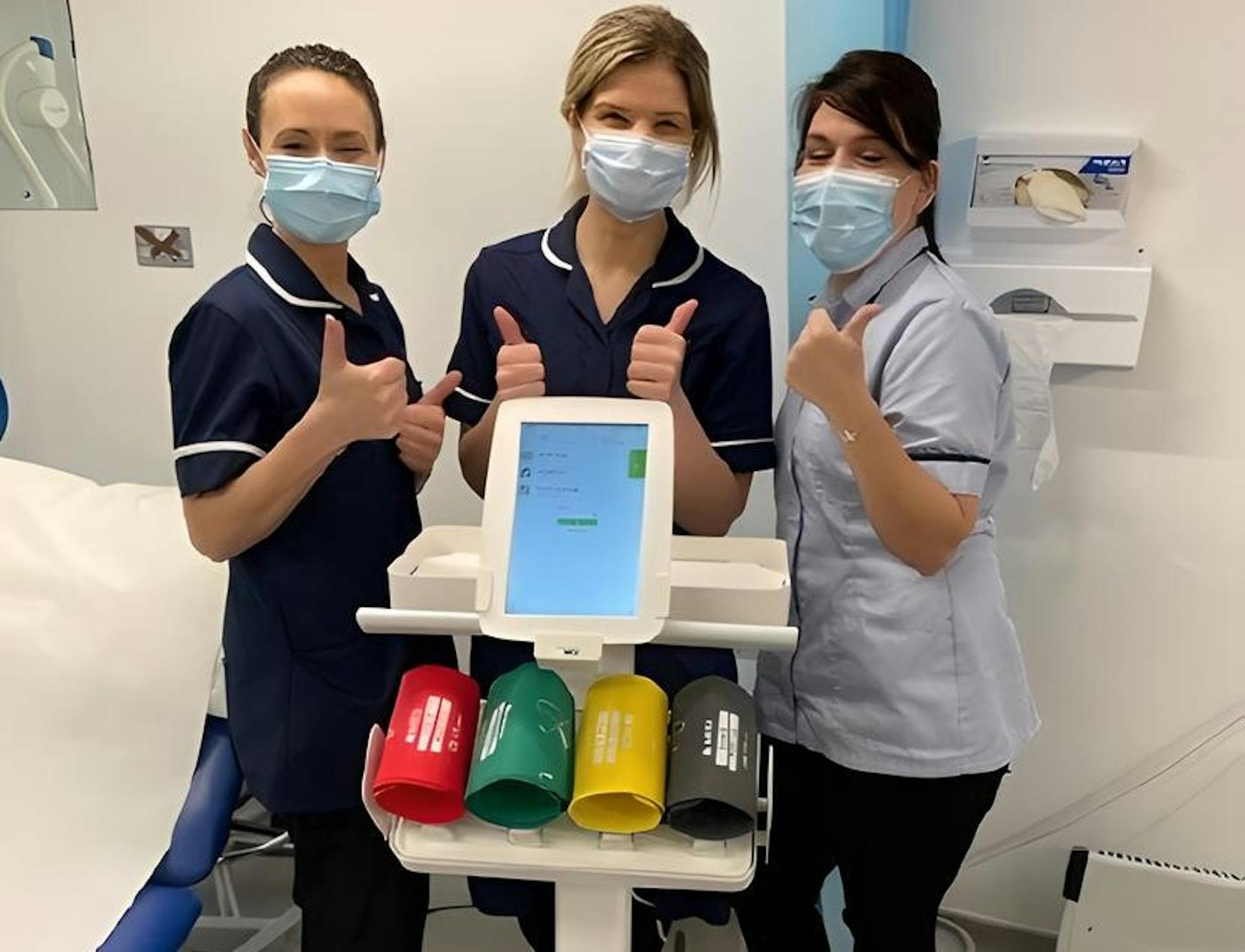
The value of integrated diagnostic approach was emphasized by Philip Heiden, Managing Partner at St Paul’s Surgery in Winchester and Adelaide Medical Centre in Andover in the UK. Reflecting on a three-year transformation of their practices, he highlighted how the MESI mTABLET streamlined workflows and enhanced patient care. He praised the simplicity and speed of performing ABI measurements with the MESI mTABLET ABI, which was significantly faster than the traditional Doppler method and saved 113 nursing hours across 340 procedures.
Measurable impact was felt in other diagnostics too. The MESI mTABLET ECG saved 50 administrative hours over 598 procedures, and the MESI mTABLET SPIRO saved 26.5 clinical hours over 159 procedures. These efficiencies translated into quicker, more focused consultations, reduced patient waiting times, and improved staff morale. He further applauded the seamless integration with EMIS (the NHS’s EHR system) enabling effortless data transfer.

Integration with existing software was also a key benefit for Dr. Jan-Ove Sanders, a general practitioner (GP) at Hausärzte Langen – Dr. Sanders und Kollegen in Germany. He shared that compatibility with tomedo®, the practice’s existing system, was a decisive factor in adopting the MESI mTABLET ecosystem. With support from MESI’s onboarding team, the practice transitioned from manual data entry (manual printing, scanning, and data transfer) to a fully digital workflow. This shift led to faster examinations, reduced administrative load, expanded diagnostic capabilities, and greater flexibility, including the ability to conduct home visits thanks to the MESI mTABLET portability.
Versatility coupled with easy integration were also recognized by Dr. Sami Gaber, a practicing GP and founder of DocPort, a German company that supports general practices in adopting integrated diagnostics. He presented a compelling case study showcasing how MESI’s technology transformed daily operations within DocPort’s “Practice as a Service” model – combining diagnostics, EHRs, lab services, billing, and more on a unified platform. A holistic approach, which will undoubtedly be embraced by many more practices, reducing healthcare workers’ workloads and improving patient outcomes and satisfaction.