The hidden costs of fragmented diagnostic workflows
Healthcare has never had more diagnostic tools at its disposal. Yet for many clinicians, the working day still starts in a surprisingly familiar way.
One measurement appears on one screen. Another arrives as a PDF waiting to be uploaded. An ECG sits in a different system behind another login. The information is all there, but it rarely exists in one place. Before a clinical decision can be made, someone has to bring the pieces together. Every single time.
The devices themselves are rarely the problem. Most are faster, smarter and more accurate than ever before. The challenge lies in everything between them: disconnected workflows, fragmented data and the time required to turn measurements into meaningful clinical information.
That challenge is becoming even more important as healthcare embraces artificial intelligence. According to the AMA Physician Survey 2026 [2], 81% of U.S. physicians now use AI in clinical practice, up from 38% in 2023. Yet despite this rapid adoption, many clinical workflows remain fragmented, making it difficult to fully realise the potential of AI.
This was one of the central themes in the keynote Rethinking Diagnostic Pathways in Modern Healthcare, delivered by Sven Jungmann at MESI Conference 2026. A physician by training who later moved into digital health entrepreneurship, Jungmann now leads aiomics, a company focused on applying artificial intelligence and data-driven systems to improve healthcare decision-making.
Working at the intersection of medicine, technology and clinical workflows, Jungmann offers a unique perspective on why healthcare still struggles to turn high-quality measurements into connected clinical decisions.
His message was simple: the future of healthcare will not be shaped by how many tools we add to the system, but by how intelligently we connect them.
“How could I re-engineer my workflow if it wasn’t there yet?”
As Jungmann reminded the audience early in his keynote, a fool with a tool is still a fool. The point was simple: technology alone does not fix broken systems. Without the right workflows, connected data and clinical logic behind it, even the most advanced diagnostic tools can add complexity instead of reducing it.
Hear it from Sven Jungmann
The keynote explored only part of the conversation.
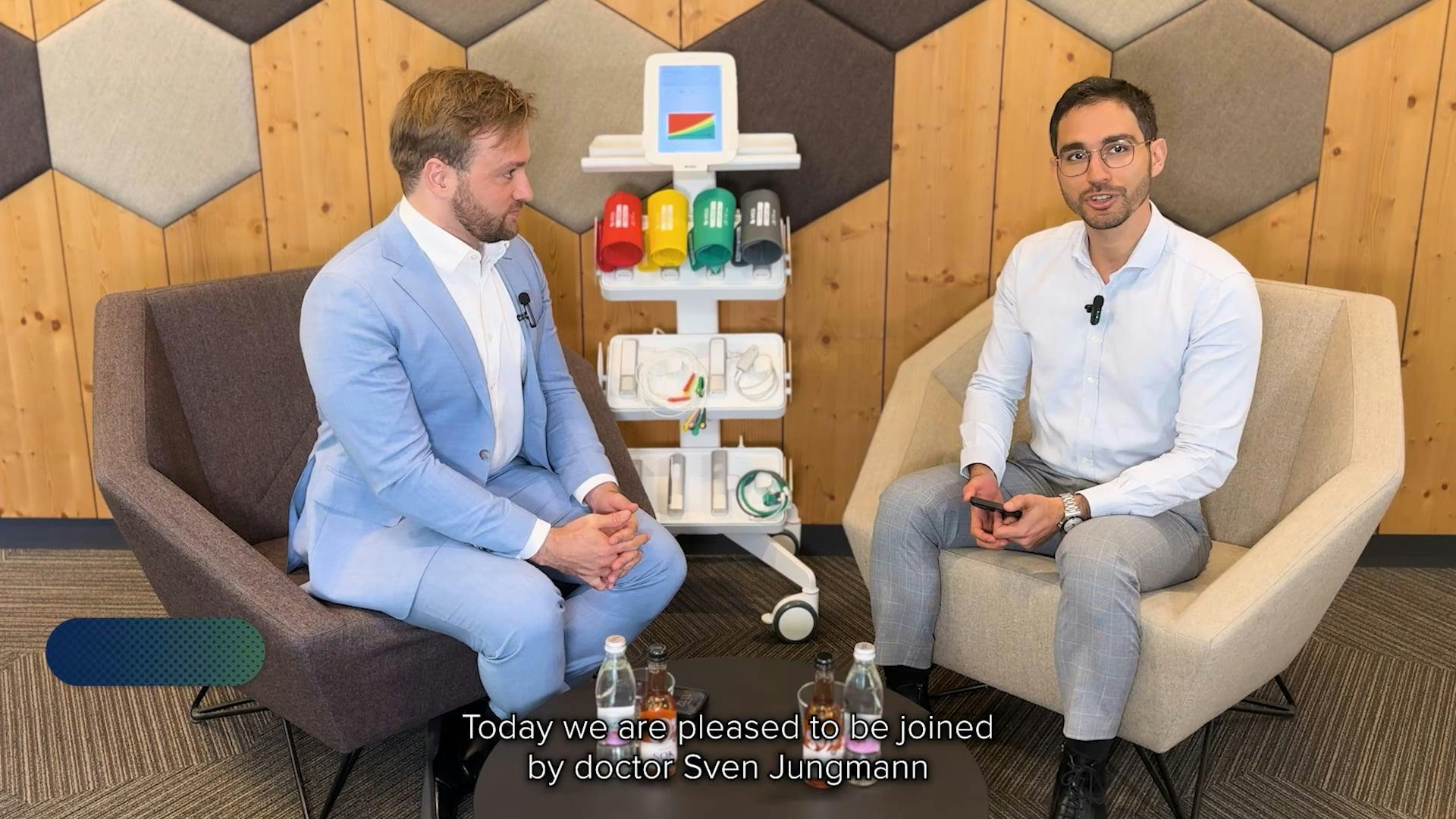
In this exclusive interview recorded at MESI Conference 2026, Sven Jungmann expands on the challenges of fragmented diagnostics, data quality, AI and the future of connected healthcare.
The hidden costs of fragmented diagnostics
Better devices, same old workflows
For years, healthcare innovation has focused on improving individual diagnostic devices. Better ECG systems, faster spirometry, smarter wearables and increasingly advanced imaging technologies have all contributed to a more precise and data-rich clinical environment. But while the tools themselves have evolved, the pathways around them often have not.
This is often where the real complexity begins, not in the measurement itself, but in everything around it.
In many healthcare settings, diagnostics still happen in fragments. One device produces one result, another device stores data elsewhere, and clinicians are left switching between interfaces, manually transferring information and piecing together a patient’s story across disconnected systems. Each step may feel manageable on its own, but together they create a workflow that is far more complex than it needs to be.
This is what fragmented diagnostics often look like in practice: clinical workflows where measurements, patient data and diagnostic reports are generated across disconnected devices and systems, without a seamless path between them.
At the core of this challenge is interoperability, or the lack of it. Without interoperability, data loses context. And without context, decision-making slows down.
The cost of fragmentation is often invisible
The cost of this fragmentation is rarely obvious because it is spread across the entire clinical day. It is the extra minutes spent logging into another system, the printed report waiting to be scanned, the manual transcription into the electronic medical record, or the follow-up call to check whether a result has actually been uploaded. None of these moments seem significant in isolation, but over time they add up to hours of lost clinical capacity.
Jungmann’s broader work in digital health often comes back to one important idea: innovation is not always about learning something new. Sometimes it is about unlearning systems and habits that no longer serve modern medicine.
As he put it, sometimes innovation means removing friction, not adding features.
This is particularly relevant in diagnostics, where many workflows still reflect legacy models built for a slower, less connected era.
Data is not the problem. Data quality is.
The challenge today is no longer collecting more data. Healthcare already produces enormous amounts of it. The real challenge is making that data usable, accessible and meaningful at the exact moment it is needed.
As Jungmann pointed out, AI is powerful, but only if the foundations underneath it are strong enough. This is where one of the most important principles of digital medicine becomes impossible to ignore: garbage in, garbage out.
Jungmann referenced recent findings published in JAMA Network Open, where physicians working alone achieved diagnostic reasoning scores of 73.7%, physicians supported by GPT-4 scored 76.3%, while GPT-4 alone reached 92.0%.
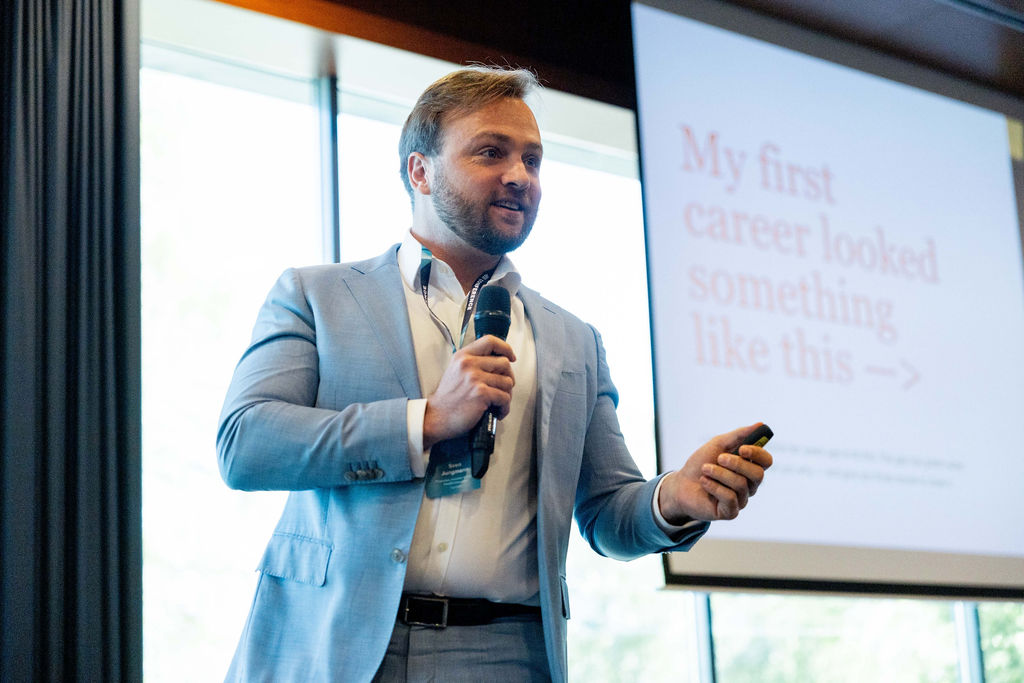
If things are scattered everywhere, you’re skipping a step.
The numbers are impressive, but they also raise an important question: if AI can outperform clinicians in isolated scenarios, what happens when the data feeding that system is incomplete, fragmented or inconsistent?
No matter how advanced an AI model, analytics platform or clinical decision-support system becomes, the quality of its output will always depend on the quality of the data going in. If diagnostic data is incomplete, inconsistent, manually entered or scattered across multiple disconnected systems, the insights built on top of it will inevitably carry the same weaknesses.
This is not just a technical issue. It is becoming one of the most important clinical challenges of modern healthcare.
Data quality is becoming clinical infrastructure
As healthcare moves further into predictive analytics, automation and AI-supported decision-making, structured and standardized diagnostic data becomes essential. Without it, healthcare risks building increasingly sophisticated systems on unstable foundations. Data quality can no longer be seen as an administrative or IT concern sitting somewhere in the background. It is becoming part of the clinical infrastructure itself.
At the same time, rapid AI adoption is creating new governance challenges. Jungmann highlighted that 40% of healthcare professionals have already encountered unauthorised AI tools within their organisations, showing how quickly technology can outpace structured clinical systems.
Reliable, structured data changes the way care is delivered. It allows clinicians to make decisions faster, improves continuity of care and makes it easier to compare results over time. It also strengthens collaboration between teams, because everyone works from the same, up-to-date clinical picture. In preventive care especially, this can make a significant difference, allowing risks to be identified earlier and interventions to happen sooner.
Not all costs are measured in time
But not all of this is measured in minutes. Some of it is measured in attention. Every additional login, every manual transfer and every disconnected report creates cognitive overhead.
We always tend to think time is our scarcest resource, but it really is our attention.
Every disconnected workflow asks something extra from clinicians. They need to remember where data is stored, whether it has been uploaded correctly, which version is the latest and whether the information in front of them can be trusted. These small moments of uncertainty create friction, and over time that friction becomes mental strain.
In healthcare systems that are already under pressure, this matters more than ever.
Burnout is not only driven by workload. It is also driven by complexity, inefficiency and the constant mental effort required to navigate systems that should be making work easier.
Technology should reduce that burden, not add to it.
The future of diagnostics is connected
This is why the conversation around diagnostics needs to evolve. The goal should not simply be to introduce more tools into clinical practice, but to create connected diagnostic ecosystems where every measurement contributes to one unified patient story. Diagnostics should not exist as isolated events, but as part of a larger clinical infrastructure designed to support faster decisions, clearer insights and more effective collaboration.
That is ultimately the shift Jungmann challenged the audience to consider. The question is no longer whether healthcare can collect more data. It clearly can.
The more important question is whether healthcare can create a single source of truth from the data it already has, and whether the systems around it are designed to turn that data into meaningful action.
Because the hidden costs of fragmented diagnostics are rarely found in the devices themselves. More often, they appear in the time lost between them, in delayed decisions, in administrative overload and in missed opportunities to act earlier.
And in modern healthcare, those are often the costs that matter most.
About Sven Jungmann:
Sven Jungmann’s work sits at the intersection of medicine, artificial intelligence and digital health systems. Through his work at aiomics and across the wider healthcare innovation space, he continues to challenge how healthcare thinks about data, workflows and decision-making. His message at MESI Conference 2026 reflected a growing reality: in a future shaped by AI, diagnostics will only be as powerful as the systems that connect them.